UK GDPR and EU GDPR
The UK GDPR and the EU GDPR are the laws that govern how organisations collect, use, share and protect personal data about people in the UK and the EU. They apply to almost every organisation that handles personal data there, as a controller or a processor, whatever its size. They are enforced by regulators; nobody certifies you against them.
What it is and who it applies to
The EU GDPR is Regulation (EU) 2016/679, which has applied since 25 May 2018. The UK GDPR is the same text kept in UK law after Brexit, read with the Data Protection Act 2018 and amended several times since, most substantially by the Data (Use and Access) Act 2025. Because the UK kept the EU’s numbering, an article number usually means the same thing in both, and this section says where they now differ.
The test for whether either law applies has two parts. First, you process personal data: any information about an identifiable living person, from a name in a CRM to an IP address in a log. Second, you have a link to the territory: you are established there, or you offer goods or services to people there, or you monitor their behaviour there (UK GDPR Article 3, and the same article in EU GDPR). A UK company with EU customers usually sits under both.
Your duties depend on your role. A controller decides why and how data is processed; a processor acts on a controller’s instructions. Most organisations are both: controller of their own staff and customer data, processor of the data their customers put into their service.
Some data needs more care. Special category data, such as health, ethnic origin, religion, sexual orientation, trade union membership and biometrics used to identify someone, needs an extra condition on top of a lawful basis. Data about criminal convictions has its own rules. Children’s data is not a separate category, but it raises the bar on transparency, consent and design.
UK GDPR
In the UK, the UK GDPR sits beside the Data Protection Act 2018, which adds exemptions, conditions for sensitive data and the regulator’s powers. The Data (Use and Access) Act 2025 changed both; most of its data protection changes took effect on 5 February 2026. An organisation outside the UK that targets people in the UK usually needs a UK representative (UK GDPR Article 27).
EU GDPR
In the EU, the regulation applies directly in every member state and across the European Economic Area, with national laws filling the gaps it leaves open, such as the age of consent for online services. An organisation outside the EU that targets people in the EU usually needs a representative in a member state (EU GDPR Article 27). Amendments proposed by the European Commission in 2025 are proposals, not law.
This is guidance to help you understand the requirement, not legal advice.
Structure
Both texts run in the same order: scope and definitions, principles, lawful basis, rights, duties of controllers and processors, transfers, then regulators and remedies. The table groups the articles you will work with, paraphrased; the numbers apply to both texts unless the row says otherwise.
| Articles | What they ask for, in plain English | Covered in |
|---|---|---|
| 1 to 4 | Who and what the law covers, and the definitions it uses | This page |
| 5 | Six principles for handling data, and proof that you follow them | Records of processing |
| 6 to 11 | A lawful basis for every use of data, with extra conditions for sensitive data | Lawful basis |
| 12 to 14 | Tell people, in plain words, what you do with their data | Transparency and privacy notices |
| 15 to 22 | Rights of access, correction, erasure, objection and others; in the UK, automated decisions now sit in new articles that replace Article 22 | Individual rights and subject access requests |
| 24 to 31 | Duties of controllers and processors: design, contracts, records, representatives | Processors and contracts, records of processing |
| 32 to 34 | Keep data secure and report breaches | Personal data breaches |
| 35 and 36 | Assess high-risk processing before you start | Data protection impact assessments |
| 37 to 39 | When you need a data protection officer, and what they do | Data protection officer |
| 44 to 50 | Rules for sending data abroad; the UK rewrote several of these articles in 2026 | International transfers |
| 51 onwards | Regulators, cooperation between them, remedies and fines | This page |
Certification and enforcement
No general GDPR certification exists. Articles 42 and 43 allow regulators to approve certification schemes for particular kinds of processing, but none covers the regulation as a whole. Compliance is shown by your records, policies and decisions, and tested when a regulator, a customer or a court asks.
Individuals can also enforce the law themselves: they can complain to the regulator and claim compensation in the courts for damage caused by a breach of it.
Regulators usually hear about an organisation through a complaint from someone whose data it holds or through a breach it reported. How you handle requests and incidents therefore decides most first contacts, and the records you keep decide how the conversation goes.
UK GDPR
The UK regulator was the Information Commissioner until 30 September 2026, when the Data (Use and Access) Act 2025 replaced that office with the Information Commission, a board-led body that still calls itself the ICO. Its powers did not change with the name.
Most cases the ICO handles end with advice or a reprimand. Where that is not enough it can issue an enforcement notice ordering specific steps, and for serious failures a penalty notice. The maximum fines are £17.5 million or 4% of worldwide annual turnover, whichever is higher, for breaches of the principles, lawful basis, rights and transfer rules, and £8.7 million or 2% for most other duties (Data Protection Act 2018 section 157).
Most UK organisations that process personal data must also pay the ICO an annual data protection fee unless they are exempt. The Data Protection (Charges and Information) Regulations 2018 set it in three tiers. Tier 1, £52, covers micro organisations: turnover up to £632,000 or no more than 10 staff, plus charities and small occupational pension schemes. Tier 2, £78, covers turnover up to £36 million or no more than 250 staff. Tier 3, £3,763, covers everyone else. Each is £5 less by direct debit, and the amounts have applied since 17 February 2025.
EU GDPR
Each EU member state has its own supervisory authority. If you have a main establishment in the EU, the authority where it sits leads on cross-border cases and cooperates with the others (EU GDPR Article 56). An organisation with no EU establishment deals with each authority where it has affected people. The European Data Protection Board brings the authorities together, publishes guidelines and settles disputes between them.
The tools mirror the UK’s: advice, reprimands, orders to comply or to stop processing, and fines. The maximum fines are €20 million or 4% of worldwide annual turnover, whichever is higher, and €10 million or 2% for the lower tier (EU GDPR Article 83). The EU GDPR sets no registration fee.
How the pieces fit
The obligations form a chain. You need a lawful basis before you process anything. Transparency tells people which basis and purpose you rely on, and their rights hang off what you told them. Processing that is high risk needs an assessment first. Data you pass to processors or send abroad carries your duties with it. Security protects all of it (UK GDPR Article 32), and the breach rules apply when that fails. Accountability (UK GDPR Article 5(2)) ties the chain together: you must be able to show each link, and your record of processing (UK GDPR Article 30) is where that starts.
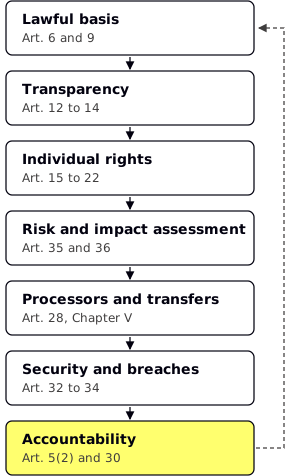
Regulators read the chain in reverse. Faced with a complaint, they ask for the record of processing, then the lawful basis it names, then the notice that told people about it. A gap early in the chain usually explains a failure later on.
In this section
- Lawful basis for processing: which of the six bases fits each use of data, and what extra condition sensitive data needs?
- Transparency and privacy notices: what must you tell people, and when?
- Individual rights and subject access requests: what can people ask for, and how fast must you answer?
- Data protection impact assessments: when must you assess processing before you start it?
- Processors and data processing agreements: what must a contract with a processor say?
- International data transfers: how do you send personal data abroad lawfully from the UK or the EU?
- Personal data breaches: when must you tell the regulator and the people affected?
- Records of processing activities: what must your record hold, and who is exempt?
- Data (Use and Access) Act 2025 changes to UK GDPR: what changed in the UK, and from when?
How Sted maps it
UK GDPR and EU GDPR are both in Sted’s catalogue, as separate entries. Sted treats each as applying when you process personal data and have a link to that territory, reads your controller and processor roles from the processing activities you describe, and notes when you need a representative. Each recommended standard shows its basis and Sted’s confidence, with the reasons it applies.
Onboarding asks about your processing activities and transfers abroad, and Summary lists them. The documents come from Sted’s knowledge base and are drafted for your organisation for you to review. For each law that means a set of policies, procedures, notices and record templates led by the Personal Data Protection Policy and the two privacy notices.
Sted has no template for a data protection impact assessment; you hold that assessment yourself. Sted does not decide your lawful basis, answer requests from individuals, or judge whether a breach must be reported. Those decisions stay with you and your advisers.

- Sted treats UK GDPR, and separately EU GDPR, as applying when you process any personal data and are established in that territory or offer goods or services to, or monitor, people there; it reads your controller and processor roles from your processing activities, notes when an Article 27 representative is needed, and holds its confidence at medium until a processing activity is recorded.
- For UK GDPR and for EU GDPR Sted’s knowledge base carries 34 policies, procedures and notices and 35 record templates each, led by the Personal Data Protection Policy, the Data Subject Rights Handling Policy, the Data Retention and Erasure Policy and the two privacy notices.
- Onboarding asks about the personal data you process, activity by activity (its purpose, who it is about, how long it is kept and whether you act as controller or processor), and about transfers abroad with their safeguard; Summary’s Data and privacy card lists the processing activities by name and status and each transfer’s recipient, role and destination.
- The card is a summary of what onboarding recorded, not a record of processing activities.
Sted does not act as your data protection officer or representative, and does not notify the ICO or a supervisory authority for you.
Frequently asked questions
Does UK GDPR apply to a small business?
Yes, if it handles personal data about anyone, including staff, customers or website visitors. Size changes very little: a business under 250 people has a narrower duty to keep records of processing, but every other obligation applies. The one real exemption is purely personal or household use.
Do I need to follow both UK GDPR and EU GDPR?
You need both when you are established in one territory and sell to, or monitor, people in the other. A London software company with customers in Munich is the common case. The two texts still match closely, so one privacy programme can meet both if it records where they differ.
Is there a GDPR certification my organisation can get?
No general GDPR certificate exists. The law allows approved certification schemes for particular processing, but none covers the regulation as a whole. A certificate to ISO 27001 or Cyber Essentials shows your security controls, which helps with Article 32, and nothing more.
Do I have to pay a fee to the ICO?
Most UK organisations that process personal data must pay the annual data protection fee unless an exemption applies. The Data Protection (Charges and Information) Regulations 2018 set three tiers by size: £52 for micro organisations, £78 for small and medium ones and £3,763 for the rest, each £5 less by direct debit. The ICO publishes a self-assessment for the exemptions, and the EU GDPR has no equivalent fee.
What did the Data (Use and Access) Act 2025 change?
It amended the UK GDPR, not the EU GDPR. The main changes, most in force from 5 February 2026, are recognised legitimate interests, clearer rules on subject access deadlines and searches, wider room for automated decisions with safeguards, and a new test for international transfers. A duty to handle complaints followed on 19 June 2026.