IEC 62304
IEC 62304 is the international standard for the life cycle of medical device software: how you plan, build, test, release and maintain it, scaled to a software safety class. Notified bodies, UK approved bodies and the US FDA expect it. It is not certifiable on its own: you show conformity inside your device’s conformity assessment.
What it is and who it applies to
The formal designation is IEC 62304:2006+AMD1:2015, Medical device software, software life cycle processes, published by the International Electrotechnical Commission. The edition in use is the 2006 first edition with Amendment 1 of 2015, which the IEC also sells as one consolidated text. Amendment 1 rewrote how you assign a safety class and added a route for legacy software. The IEC was preparing a second edition in 2026, with a simpler two-level safety classification planned; until it is published, the amended first edition is the one assessors use.
The standard applies to any manufacturer whose medical device is software or contains software. That covers software as a medical device (SaMD), such as a diagnostic app or a clinical decision tool, and firmware embedded in a physical device such as an infusion pump. It covers maintenance as well as development, so a team that only updates a released product is in scope too.
IEC 62304 assumes two systems are already in place. You develop the software inside a quality management system, usually ISO 13485, and you manage risk with ISO 14971, the device version of the method in the risk assessment guide. The standard does not repeat either; it plugs into them.
Whether your software is a medical device at all is a question of intended purpose under the regulation, not of this standard. MDCG 2019-11 is the European guidance on qualifying and classifying software; MDCG 2019-16 covers cybersecurity. IEC 82304-1 covers health software products more widely, and IEC 81001-5-1 adds security activities to the same life cycle.
This is guidance to help you understand the requirement, not legal advice.
Structure
Clauses 1 to 3 set out the scope, references and definitions. The requirements sit in clauses 4 to 9. Each process requirement says which safety classes it applies to, so a class A product does less than a class C one. The table paraphrases each part.
| Clause | What it asks for, in plain English | Covered in |
|---|---|---|
| 4 | Work inside a quality system and a risk process, assign each software system a safety class, and decide how to handle legacy software | This page; ISO 13485 quality management system |
| 5.1 | Plan the development: the processes, standards, tools, deliverables and how you will trace them | This page; ISO 13485 design and development |
| 5.2 | Write the software requirements, including the risk controls the software must carry | This page |
| 5.3 and 5.4 | Break the software into items, document the interfaces and any segregation, and design units in detail where the class needs it | This page |
| 5.5 to 5.7 | Write and verify the units, integrate them, and test the whole system against its requirements | This page |
| 5.8 | Release only when verification is complete, known residual anomalies are evaluated and the released version is recorded | This page |
| 6 | Plan maintenance, analyse each problem and change request, and implement modifications through the same processes | This page |
| 7 | Find where software can contribute to a hazardous situation, add and verify risk controls, and assess the risk of every change | This page |
| 8 | Identify every configuration item, including third-party software, control changes and keep a status record | This page |
| 9 | Report, investigate and resolve problems, tell the people affected, and look for trends | This page |
The three safety classes
IEC 62304:2006 4.3 asks you to classify each software system by what a software failure could lead to, after counting risk controls outside the software. Class A means the software cannot contribute to a hazardous situation, or the resulting risk is acceptable; class B means it can lead to an unacceptable risk whose worst possible harm is a non-serious injury; class C means that harm could be death or serious injury. Until you have assigned a class, the class C requirements apply.
You may split a system into software items with different classes, but only where the architecture shows the lower-class item cannot affect the higher-class one. Class A needs the least: planning, requirements, system testing, release, maintenance, risk management, configuration management and problem resolution. Class B adds architectural design (IEC 62304:2006 5.3), unit verification and integration testing. Class C adds detailed design of each unit (IEC 62304:2006 5.4) and extra acceptance criteria for units.
Software of unknown provenance and legacy software
Almost every product uses software it did not write: an operating system, a database driver, an open-source library. IEC 62304 calls this software of unknown provenance (SOUP), and it also covers code you wrote earlier without adequate development records. You record each SOUP item by title, maker and version under configuration management, and state the functional and performance requirements it must meet. Risk management then has you review its published anomaly list for anything that could contribute to a hazardous situation (IEC 62304:2006 7.1).
IEC 62304:2006 4.4, added by Amendment 1, gives a route for legacy software already on the market: assess its post-market history, run a gap analysis against the standard, and close the gaps that matter to safety, rather than redocumenting the whole product.
Certification and enforcement
No accredited certification scheme exists for IEC 62304 in the way one does for ISO 13485, and no certificate to it opens a market. Some testing organisations offer a voluntary assessment against the standard; it is not a conformity assessment route. What counts is how your software evidence fares in your device’s own conformity assessment.
In the EU
The EU MDR asks for software to be developed and manufactured in line with the state of the art, taking account of the development life cycle, risk management including information security, and verification and validation (EU MDR Annex I, section 17.2). The technical documentation must hold the software verification and validation evidence (EU MDR Annex II).
As at the amendment of 11 June 2026, EN 62304 was not among the harmonised standards listed under Regulation (EU) 2017/745 in Implementing Decision (EU) 2021/1182. Following it therefore gives no automatic presumption of conformity. Notified bodies nevertheless treat it as the state of the art, so in practice you either follow it or justify an equivalent process in your technical documentation.
The device’s class sets who checks the work. Software that informs diagnostic or therapeutic decisions is at least class IIa under EU MDR Annex VIII Rule 11, and higher where a wrong decision could cause serious or irreversible harm. A notified body then audits your quality system and reviews technical documentation: on a sampling basis for class IIa and IIb, and for every class III device. Class I software is self-declared, with no notified body.
In Great Britain and the US
In Great Britain, EN 62304:2006 with its 2008 corrigendum has been a designated standard under UK MDR 2002 since 1 January 2021; the designation does not include Amendment 1. A UK approved body reviews the software evidence for devices above Class I. In the US, the FDA lists the amended IEC 62304 among its recognised consensus standards, so a submission can declare conformity with it.
What triggers trouble is a documentation gap: no safety class rationale, a SOUP list that does not match the build, or anomalies released without evaluation. These appear as notified body nonconformities and delay the certificate until they are closed.
How the pieces fit
The processes form a loop around risk management. Risk analysis tells you the safety class and the risk controls the software must carry. Planning (IEC 62304:2006 5.1) fixes how you will work. Requirements (IEC 62304:2006 5.2) turn intended use and risk controls into testable statements. Architecture and detailed design break the software into items. Units are built and verified (IEC 62304:2006 5.5), integrated (IEC 62304:2006 5.6) and tested as a system (IEC 62304:2006 5.7). Release (IEC 62304:2006 5.8) records exactly what shipped and which known anomalies remain.
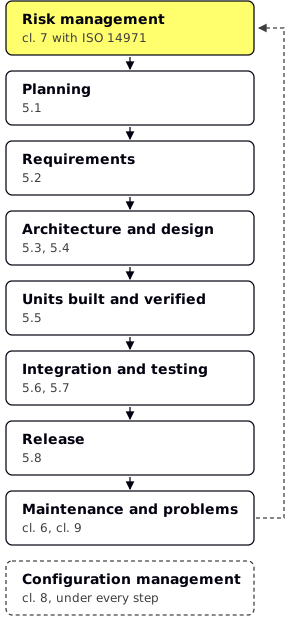
After release, maintenance (IEC 62304:2006 6) and problem resolution (IEC 62304:2006 9) send every field problem and change request back into the loop: each change is risk-assessed (IEC 62304:2006 7) and goes through the same development steps at its class. Configuration management (IEC 62304:2006 8) runs underneath all of it, so you can always say which version of which item, including every SOUP item, is in a given release.
Traceability is what an assessor follows. They pick a hazard from the risk file, find the requirement that controls it, the design item that implements it, the test that verifies it and the release that shipped it. A broken link anywhere on that chain is the first finding.
In this section
IEC 62304 is covered on this page; it has no sub-pages. The topics it depends on and feeds into have their own pages:
- ISO 13485 design and development: how design planning, reviews, verification and validation work for the device as a whole?
- ISO 13485 quality management system: what quality system must your software process sit inside?
- EU MDR classification: what class does Rule 11 give your software, and who assesses it?
- EU MDR technical documentation: where does your software evidence go in the file a notified body reviews?
- UKCA marking under UK MDR 2002: how does the same software evidence support a UKCA mark in Great Britain?
- IEC 62366-1: how do you engineer and evaluate the user interface your software presents?
How Sted maps it
IEC 62304 is one of the standards, regulations and schemes in Sted’s catalogue.
Sted treats it as mandatory when a product that is or contains software carries design responsibility under a device regulation that applies to you, or when a clinical investigation is planned or running. It carries forward the highest software safety class you recorded, and while the device regulation is still pending, so is IEC 62304. Those rules work from your recorded answers; the AI model does not decide them.
Sted recommends it with its reasons, and you select it or leave it. Administrators and Policy and Process Owners make that choice. Choosing it and pressing Update and generate framework builds the documents it needs.
For IEC 62304 Sted’s knowledge base carries the Software Development Lifecycle Procedure (PRC-SDLP), the Software Maintenance Procedure (PRC-SWMAINT) and their record templates, from the Software Development Plan (REC-SDP) to the SOUP Item Record (REC-SOUP) and the Software Release Record (REC-SR), over a 13-row process catalogue. The procedures are drafted for your organisation for you to review and approve, and each record template gives your evidence a fixed shape. The software risk work sits in the medical device risk management plan and file under the Risk Management Procedure. Because the standard has a catalogue, adopting it also gives you a Statement of Applicability for its 13 process rows, where you can mark a row excluded with a reason, such as detailed design for a class A product. See Records, Documents and Classification and applicability for how they work in StedOS.
Sted does not assign your safety class, review your code or test your software. It holds the procedures, plans and records an assessor samples, as documented information under your own document control.

- For IEC 62304 Sted’s knowledge base carries four procedures, the Software Development Lifecycle Procedure (PRC-SDLP), Software Maintenance Procedure (PRC-SWMAINT), Usability Engineering Procedure (PRC-UEP) and Risk Management Procedure (PRC-RMP), and 11 record templates: the Software Development Plan (REC-SDP), Software Requirements Specification (REC-SRS), Software Architecture Document (REC-SAD), Requirements Traceability Matrix (REC-RTM), Verification and Validation Plan (REC-VVP), Software Release Record (REC-SR), SOUP Item Record (REC-SOUP), Problem Report (REC-MDPR), Change Impact Assessment Record (REC-CIA), Medical Device Risk Management File (REC-MDRM) and Medical Device Risk Management Plan (REC-MDRMP), with a 13-row process catalogue over clauses 5 to 9.
- Under the same Risk Management Procedure (PRC-RMP) Sted’s knowledge base carries an AI Risk Assessment Record (REC-ARA) for each AI system, with a suggested annual frequency, and for medical devices a Medical Device Risk Management Plan (REC-MDRMP), Medical Device Risk Management File (REC-MDRM) and Risk Management Report (REC-RMR).
- Records are part of the Full Management System plan.
Sted does not assign the software safety class or verify the software. The class is the conclusion of your risk analysis, and the notified body tests it.
Frequently asked questions
Does IEC 62304 apply to a mobile app?
Yes, if the app is a medical device or part of one: its intended purpose decides that, not the platform it runs on. A symptom checker that suggests a diagnosis is usually a device, while a step counter or a booking app usually is not. Health software that is not a device is better served by IEC 82304-1, which itself points back to IEC 62304 for the development process.
What software safety class is my product?
Class A if a software failure cannot lead to an unacceptable risk once risk controls outside the software are counted, class B if it can and the worst possible harm is a non-serious injury, and class C if that harm could be death or serious injury. You judge it from your risk analysis, taking credit only for controls outside the software. Until you have assigned and documented a class, the class C requirements apply.
Can I use open-source libraries in medical device software?
Yes. IEC 62304 treats them as software of unknown provenance (SOUP): you identify each one by name and version, state what you need it to do, review its published bug list for anything that could contribute to a hazard, and control upgrades. An auditor checks the list against what is actually in your build.
Is IEC 62304 a harmonised standard under EU MDR?
No. As at the amendment of 11 June 2026, the list of harmonised standards under Regulation (EU) 2017/745 did not include it, so following it gives no legal presumption of conformity. Notified bodies still treat it as the state of the art for software, so you will be asked to show conformity with it or justify an equivalent.
Can we use agile development and still comply with IEC 62304?
Yes. The standard sets out activities and outputs, not a sequence, so sprints can deliver requirements, design, code and tests in small increments. What matters is that each release has traceable requirements, verification evidence and a documented decision to release. AAMI TIR45 gives detailed guidance on running agile under the standard.