UK MDR 2002 and UKCA marking
UK MDR 2002, the Medical Devices Regulations 2002 as amended, is the law for placing a medical device on the market in Great Britain. The MHRA enforces it. A device reaches the market with a UKCA mark after conformity assessment, usually by a UK approved body, or for now with a CE mark. Northern Ireland follows EU MDR instead.
What it is and who it applies to
The formal citation is the Medical Devices Regulations 2002 (SI 2002/618). They were made to implement three EU directives, on general devices, active implantable devices and in vitro diagnostics. Since 1 January 2021 they have run as a separate Great Britain regime, built on those directives as the UK amended them, not on EU MDR. Their annexes still apply in the form Medical Devices Regulations 2002 Schedule 2A modifies.
They apply to anyone placing a device on the market or putting it into service in England, Wales or Scotland: manufacturers above all, and anyone who supplies devices. Before a device is placed on the market, the manufacturer or its UK Responsible Person registers it with the MHRA (Medical Devices Regulations 2002 regulation 7A). A manufacturer based outside the UK appoints a sole UK Responsible Person, whose status regulation 60 sets out.
Northern Ireland is different. Under the Windsor Framework, EU MDR has applied there since 26 May 2021, so a device sold in Northern Ireland needs a CE mark. Where a UK notified body did the assessment, the UKNI mark sits beside it.
The regime is being rebuilt in stages. Strengthened post-market surveillance rules came into force in June 2025. From 16 February to 10 April 2026 the MHRA consulted on recognising CE-marked devices indefinitely; as at 17 October 2026 no outcome had been published. Further rules on pre-market requirements have been announced but are not yet law.
This is guidance to help you understand the requirement, not legal advice.
Structure
The regulations are organised in Parts by device type, with general provisions around them. The Parts that matter to most device makers are the ones below.
| Part | What it asks for, in plain English | Covered in |
|---|---|---|
| Part I | Interpretation, scope, and transitional and saving provisions | This page |
| Part II | General medical devices: classification, registration, essential requirements, the UK mark and the conformity assessment route per class | UKCA marking |
| Part III | Active implantable devices: the same steps for that device type | UKCA marking |
| Part IV | In vitro diagnostic devices: the same steps under the directive-based rules for diagnostics | This page |
| Part 4A | Post-market surveillance: the plan, serious incident and trend reporting, field safety corrective actions, surveillance reports and periodic safety update reports | This page |
| Part V | Approved bodies: designation and the UK marking of products | UKCA marking |
| Part VI | Fees charged by the MHRA, including registration | UKCA marking |
| Part VII | Enforcement and the status of the UK Responsible Person | This page |
| Schedule 2A | How the directive annexes are modified for Great Britain | UKCA marking |
Classification follows the 18 rules of the general devices directive’s Annex IX (Medical Devices Regulations 2002 regulation 7), not the 22 rules of EU MDR. The essential requirements of regulation 8 play the part EU MDR’s general safety and performance requirements play.
Certification and enforcement
Like EU MDR, the regime is enforced, not certified. The manufacturer declares conformity and affixes the UK mark, and an approved body is involved for every class above Class I, and for a Class I device supplied sterile or with a measuring function (Medical Devices Regulations 2002 regulation 13). Approved bodies are designated by the MHRA and listed on the government’s UK Market Conformity Assessment Bodies database; they assess for UKCA only, not for CE marking.
There are two routes to the Great Britain market today:
- UKCA: classify under the retained rules, meet the essential requirements, pass the conformity assessment for the class, sign the declaration and affix the UKCA mark (Medical Devices Regulations 2002 regulation 10).
- CE acceptance: a device that has met EU MDR in full is treated as meeting the main UK requirements (Medical Devices Regulations 2002 regulation 19C). The UK government accepts it until 30 June 2030; a device certified under the old directive is accepted until its certificate expires or 30 June 2028, whichever is sooner.
Registration, the UK Responsible Person and post-market surveillance apply on both routes. A serious incident is reported to the MHRA within 15 days of awareness, 10 days for a death or an unanticipated serious deterioration and 2 days for a serious public health threat (Medical Devices Regulations 2002 regulation 44ZH).
The Secretary of State, acting through the MHRA, has the duty to enforce the regulations (Medical Devices Regulations 2002 regulation 61). Most cases begin with the MHRA’s Devices Compliance Unit explaining how to comply. Where a company does not cooperate, or the risk to health is serious, the MHRA serves compliance, suspension, safety or information notices under the Medicines and Medical Devices Act 2021, and a safety notice can require a recall. Breaching a notice is an offence. A classification dispute between a manufacturer and an approved body goes to the Secretary of State (Medical Devices Regulations 2002 regulation 7(2)).
How the pieces fit
On the UKCA route the steps run in a line, then loop. You classify the device, meet the essential requirements and document how, pass conformity assessment for the class, then sign the declaration and affix the UK mark. Registration with the MHRA, through your UK Responsible Person if you are outside the UK, comes before the device is placed on the market. Post-market surveillance under Medical Devices Regulations 2002 Part 4A then feeds back into the risk file and the technical documentation.
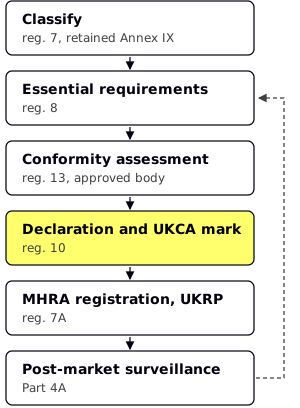
The CE acceptance route skips the middle of the loop, not its ends. You still register, still appoint a UK Responsible Person if you need one, and still meet Part 4A, which is why manufacturers relying on a CE mark should already know their Great Britain class: it decides the surveillance cadence today and the UKCA route later.
In this section
- UKCA marking for medical devices: what are the steps from classification to the UKCA mark, and how long does the CE mark still work?
The EU side is on the EU MDR hub, with device classification under EU MDR for the 22 EU rules. The quality system under both regimes is ISO 13485, with IEC 62304 for software and IEC 62366-1 for usability.
How Sted maps it
UK MDR 2002 is one of the regulations in Sted’s catalogue.
Sted treats it as applying when a product qualifies as a medical device, you intend to sell it in the UK and you hold an economic-operator role for it. It reports two positions: Great Britain under UK MDR 2002, noting when you need a UK Responsible Person, and Northern Ireland under EU MDR. One set of quality, risk, usability and software records serves both. Those rules, and the device’s class, come from your recorded answers; the AI model does not decide them.
Sted classifies a device for Great Britain separately from the EU and shows the class, the rule and the reasoning. The class remains your determination, which your approved body checks. See how Sted decides what applies to you.
Sted recommends the regulation with its reasons, and you select it or remove it. Administrators and Policy and Process Owners decide. Update and generate framework builds the documents.
Sted’s knowledge base ties the Post-Market Surveillance and Vigilance Procedure and the Problem Report to UK MDR 2002 directly; the rest of the device record set comes through ISO 13485 and the IEC standards. Each document is drafted for your organisation for you to review and approve. Audit readiness shows how much of it is done.
Sted does not act as your UK Responsible Person, register devices with the MHRA, assess conformity or report incidents. You, your approved body and your UK Responsible Person do.

- For a medical device, Sted classifies it per market and shows the regulation, class and rule with the reasoning.
- The classification is information for you and your notified body or regulator to check, not a verdict.
- For UK MDR 2002 Sted’s knowledge base carries one procedure, the Post-Market Surveillance and Vigilance Procedure (PRC-PMSV), and one record template, the Problem Report (REC-MDPR), tagged to it; the quality-system, risk, usability and software records it needs come through ISO 13485, ISO 14971, IEC 62366-1 and IEC 62304, and the Great Britain classification comes from the retained Annex IX rules.
Sted does not act as your UK Responsible Person, register a device with the MHRA, assess conformity or report an incident. Your approved body and the MHRA check the evidence.
Frequently asked questions
Do I need a UKCA mark to sell a medical device in Great Britain?
Not yet, if your device carries a valid CE mark. The UK government accepts devices CE marked under EU MDR until 30 June 2030, and devices under the old Medical Device Directive until their certificate expires or 30 June 2028, whichever comes first. You still register the device with the MHRA and, if you are outside the UK, appoint a UK Responsible Person.
Is a UKCA mark accepted in Northern Ireland or the EU?
No. Northern Ireland follows EU MDR, so a device there needs a CE mark, with the UKNI mark beside it when a UK notified body did the assessment. The EU and the EEA do not recognise UKCA either.
Who can act as my UK Responsible Person?
A person established in the UK whom you appoint, as the sole UK Responsible Person for the devices concerned, to act for you as a manufacturer based outside the UK. They register your devices with the MHRA, keep your technical documentation and declaration available, pass on incident reports and cooperate on corrective action, and they can be proceeded against as if they had placed the device on the market.
How much does MHRA device registration cost?
£240 per application, the standard fee since 8 February 2024. Registration is needed before a device is placed on the Great Britain market, whichever mark it carries.
Does my software device have the same class in Great Britain as in the EU?
Not always. The rules in force in Great Britain have no software rule of their own, so much decision-support software that EU MDR Rule 11 puts in Class IIa or higher stays in Class I in Great Britain. Classify the device under each set of rules and keep both rationales.